






 DARK
 5
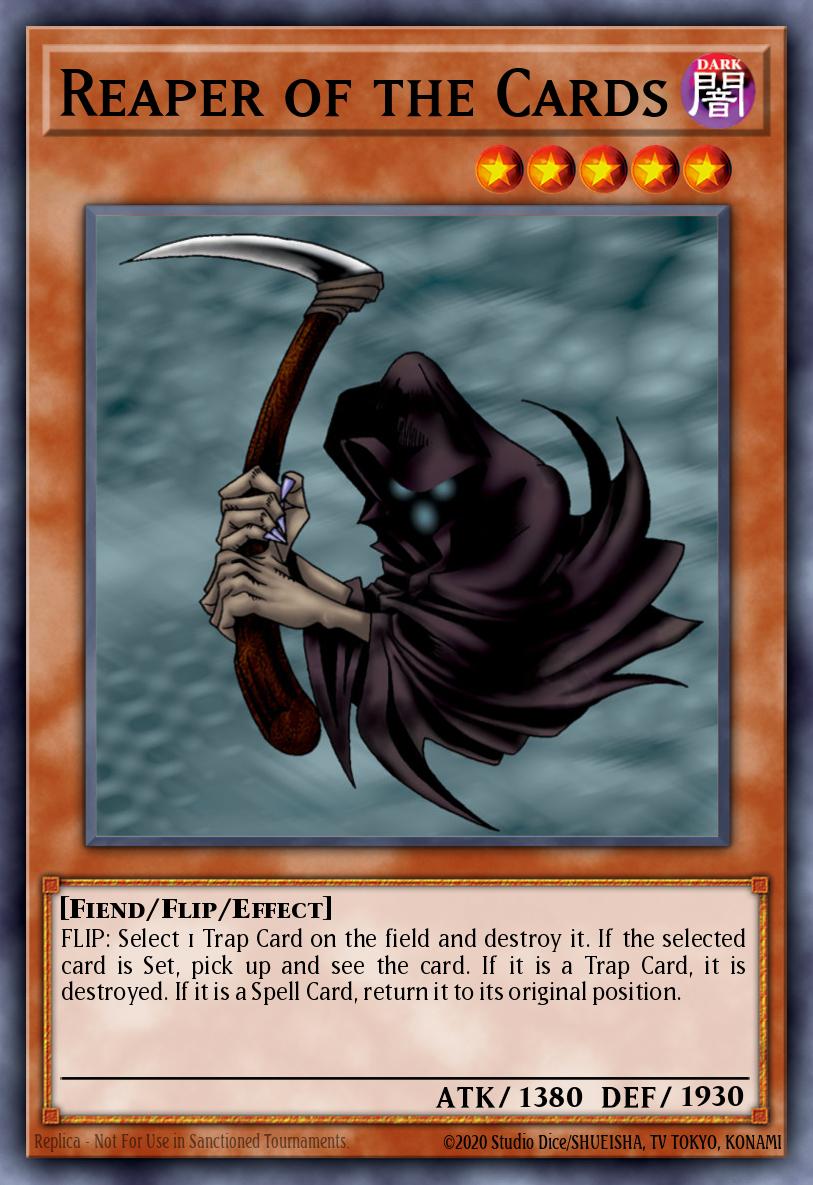
Reaper of the Cards
ATK:
1380
DEF:
1930
View:
3599
FLIP: Select 1 Trap Card on the field and destroy it. If the selected card is Set, pick up and see the card. If it is a Trap Card, it is destroyed. If it is a Spell Card, return it to its original position.
Reaper of the Cards — Power Evaluation
Final Score: 43 ± 5 · Confidence: Medium
- Intrinsic: 44 · Deck: 42 · Meta: provisional
- Primary role: Board breaker · Secondary: Removal, Tech
Why it scores here
Reaper of the Cards is a trap-destruction tech card with clear utility in Classic and trap-control formats, appearing across 16 distinct archetypes and pairing with top-tier removal like Raigeki and Dark Hole. However, its single Trap Card destruction when flipped provides no board generation, combo extension, or resource advantage—purely situational interaction. The card's 1380 ATK and 1930 DEF contribute material value, not power scaling. At 43, it represents serviceable niche tech for trap-heavy strategies but falls short as a core piece due to narrow scope and face-down fragility.
Axis scores
| Axis | Score | Evidence |
|---|---|---|
| Accessibility | 40 | Level 5 body requiring face-down setup; moderately accessible in Classic formats but no special search routes—35 decks across 16 archetypes with 1.63 average copies confirms practical but not premium inclusion (observed). |
| Combo & Conversion | 15 | Single Trap destruction on flip with no board generation, extra bodies, or combo extension; zero combo board appearances confirms no synergy as a combo driver (observed). |
| Resource Economy | 35 | Card-neutral transaction: trades this card for opponent's one Trap Card with no net advantage or refuel (inferred from effect text). |
| Effect & Interaction | 42 | Destroys Trap Cards unconditionally but does not touch hand traps, monsters, Spell Cards (returns them instead), or GY resources—clear but narrow scope (verified by card text). |
| Material Utility | 55 | Clean Level 5 DARK Fiend body with no material locks or restrictions; serviceable material value even when effect is blanked or unresolved (verified by type and stats). |
| Resilience & Flexibility | 30 | Fragile face-down dependency; vulnerable to opponent's Flip effects, effect negation, or banish before activation; Flip effect triggers once per copy with no recurring value (inferred from Flip mechanic). |
| Deck-Building Efficiency | 48 | Takes a main deck slot as Level 5 monster; usable as Normal Summon body, not a brick; average 1.63 copies per deck suggests 1–2 copy inclusion threshold (observed from distribution). |
Calculation
Weight profile: 0.7 Board breaker + 0.3 Utility. Intrinsic ≈ 44, Deck ≈ 42, Meta = provisional. Modifiers: none. Final formula: 0.40*Intrinsic + 0.60*Deck
Strengths
- Unconditional Trap Card destruction provides clear, reliable board interaction.
- Multi-archetype presence across 16 distinct homes confirms genuine utility rather than niche one-off.
- Level 5 body provides material and Normal Summon fallback value.
- Partners with top-tier generic removal (Raigeki, Dark Hole, Monster Reborn) indicating proven deck integration.
Weaknesses
- No combo generation or board presence; pure reactive situational tech with zero synergy.
- Fragile face-down setup vulnerable to opponent's Flip effects, negation, or banish before activation.
- Narrow interaction: only destroys Traps (not Spells), ignores hand traps, monsters, and GY resources.
- Low copy counts (1.63 average, peaks at 1 copy) suggest marginal fit per archetype despite broad spread.
- No competitive Top-Card ranking, no guides, zero combo board appearances—not a meta driver.
Counters / choke points
- Decks with few or no Set Trap Cards (pure monster or Spell-focused strategies).
- Effect negation before Flip triggers (e.g., Swordsoul Strategist Longyuan, Ghost Ogre & Snow Rabbit).
- Opponent's Flip effects or banish effects that activate before your turn.
- Going-first decks that do not leave Set Traps on field for you to target.
Best use
Trap-destruction tech for trap-heavy metas. Decks: Greed, Hole, Archfiend, Ninja, Solemn, Classic formats.
Evidence & gaps
- Verified: FLIP: Select 1 Trap Card on field and destroy it; if Set, peek and resolve based on actual card type (verified by card text).; 35 recent decks across 16 distinct archetypes include this card (verified by deck evidence).; Distribution: 1 copy (18 decks), 2 copies (12 decks), 3 copies (5 decks); average 1.63 per deck (verified by deck data).; Top partners are generic board clears: Raigeki (82.9%), Dark Hole (80%), Monster Reborn (94.3%) (verified by deck partnerships).; Not ranked in any format Top-Card competitive lists (verified by top-card data = false).
- Observed: 16 distinct archetypes run this card, indicating arch-agnostic trap tech utility (observed from archetype spread).; 62.9% of decks are gameplay type 6 (Classic format based on Pot of Greed, Summoned Skull, Mystical Elf partner presence) (observed).; Zero combo board appearances across all recorded boards; not a combo driver or starter (observed from combo data).; 1-copy inclusion peaks at 51.4% of decks, 2-copy at 34.3%, 3-copy at 14.3%; suggests most decks prefer 1 copy (observed).
- Inferred: Accessibility depends on deck's face-down setup mechanisms; Level 5 with no special summon text limits self-access (inferred from card type and role).; Combo conversion minimal: single Trap destruction generates no extra summons, board presence, or synergy chains (inferred from effect scope).; Resource economy is neutral: trades one card (this monster) for one opponent card (the Trap) with no advantage swing (inferred from effect mechanics).; Material utility serviceable: Level 5 DARK Fiend has no restrictions and remains usable material even if Flip effect negated or unused (inferred from type and mechanics).; Resilience low: face-down reliance and single-trigger Flip effect make it vulnerable to early interaction (inferred from Flip mechanic).
- Data gaps: No combos supplied—combo conversion, board generation, and synergy are text-only inference. No guides supplied—no human commentary on role, meta context, or historical use. No banlist token—assumed unlimited (3 copies per format). No usage statistics (StatisticsCard rows)—archetype inclusion percentages and per-archetype copies inferred from 35-deck sample only, not historical average. No top-card ranking—cannot confirm competitive meta presence or power tier.